Improving economic writing at A-level, part 2: more cohesive essays
This is the second part of my write-up from the session I ran at the Bank of England Teacher Conference. The first part was all about sentence-level work, and you can find that here. This part is about moving beyond sophisticated sentences to more sophisticated overall pieces of work.
It's worth remembering here that essay writing isn't one skill. It's probably dozens of skills bundled together, and there are loads of ways to make writing better. A lot of them sit around our assessment objectives: better analysis, better evaluation, better application etc all of which feed into better essays. This post isn't really about those. It's about how a student who is already getting the economics right can turn that into one essay that hangs together, rather than a pile of correct but separate points.
In the session I talked about two strategies, and they do slightly different jobs. The first makes sure the essay is actually answering the question, and makes that answering explicit, by setting out success criteria in the introduction and then testing every point against them. The second stops the essay being six separate answers to the same question, linking the paragraphs together so the points reconcile with one another, turning a list into an argument, which pays off when it comes to the conclusion.
Before the two strategies, here is the shape of the whole thing. Building a cohesive essay this way comes down to a seven-step process: the first three steps are strategy one, getting the essay to answer the question, and the last four are strategy two, linking the paragraphs together and pulling everything into a conclusion. (PDF at the end if you want to print this out!)
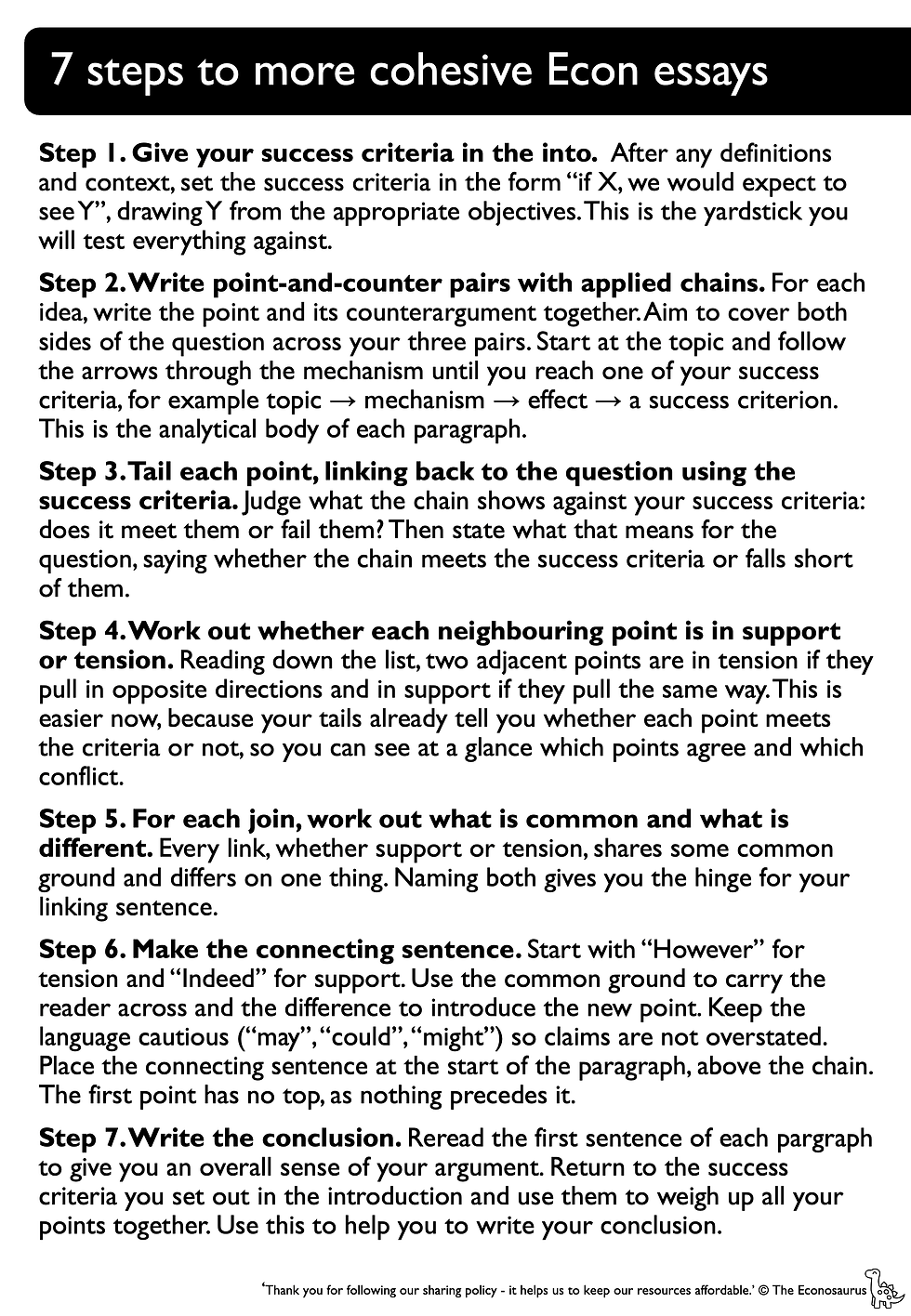
Strategy one: answering the question with success criteria
This strategy covers the first three steps of that process.
This one starts with the introduction, which I know can be a bit controversial. If a student wrote a lovely introduction and then stopped, I know that they would likely get few or even no marks for it. However, I still think introductions earn their keep:
Firstly, a solid introduction routine can help students get started (and getting starting is pretty essential to gaining any marks at all). Secondly, they stop students setting off in the wrong direction, because writing the introduction forces them to look properly at the question and check they haven't misread it or wandered off.
Thirdly, and this is the one that matters most for this post, an introduction gives students something to link back to, which is what makes the essay more focused and cohesive. For those three reasons I think introductions are worth it, even where they aren't picking up marks in their own right.
I tend to recommend starting with definitions of any key terms from the question. I know that's a bit controversial too, but it's a simple way to banish the blank page, and I'd lean on it particularly with students who are likely to drift off track. Then give a bit of background and context, something useful for the rest of the essay. If we're talking about a policy, I like to say what the problem with the market is and how the government already intervenes.
Then we get to the important bit, the success criteria. This is the tool I think does the heavy lifting. Students set out the test using the “if… we would expect to see…” structure from the first post. For example: “if the market structure were considered beneficial for consumers, we would expect to see low prices, high quality, wide choice, easy access and successful product innovation.” This is really useful, because it tells students exactly where the chains of analysis in their body paragraphs need to end up, and it gives them a ready-made structure for the conclusion, where they assess everything against those same criteria.
(In the session I also mentioned adding a “whilst” statement to the introduction. That isn't really about cohesion as such, so I'll leave it aside here. If you want to read about whilst statements, have a look back at the first post.)
Here are two worked introductions, one micro and one macro. We'll use these essay questions as examples later.
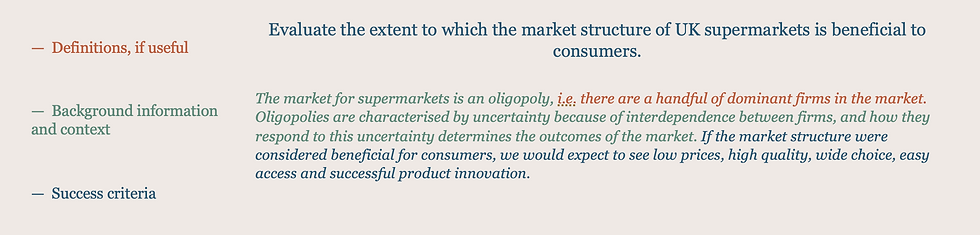
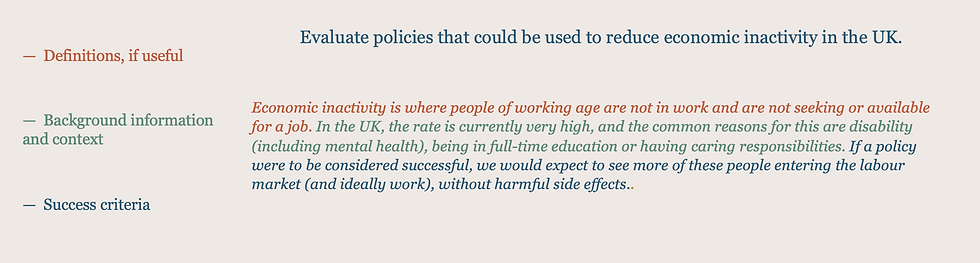
The success criteria are what hold the essay together and is the thing all paragraphs have in common (see image below) . Every body paragraph should end by linking back to them (ideally at the end). The first paragraph's chain of analysis needs to land on one of the success criteria, and the evaluation is then framed as whether that criterion has actually been met or not. The same happens in each paragraph after it. We often tell students to “link back to the question”, and this just makes that a little more clear. Then the conclusion looks across all the arguments and asks, ‘Overall, were the success criteria met?’.

Strategy two: turning six points into one argument
Disclaimer: This bit is quite complicated to explain in writing (it’s easier in person!), but I’ve tried my best. I would very much recommend either working through one of the examples or actually trying this out with an essay you’re already familiar with.
The second strategy covers steps 4-7 and is all about building cohesion between the paragraphs.
Image an 8 paragraph essay: Intro + 3 points + evaluation for each + conclusion. The aim is to stop those middle paragraphs being six separate answers to the question and start showing how they fit together and reconcile with one another.
When we write essays ourselves we probably link our points together without ever consciously deciding to. A big part of good writing instruction, though, is making the implicit explicit. Alex Quigley's The Writing Gap is good on that idea if you fancy reading a bit more.
The first thing I'd get students to do is look at each pair of neighbouring points and just note whether they're in tension or in support of/with each other. The point and its evaluation within a pair are likely to be in tension, but depending on how the paragraphs are ordered, some neighbours will support each other and some will pull against. That already gives a clue to how the linking sentence will start.

The linking sentence tops each paragraph, so it always sits at the start of the next paragraph rather than the end of the one before. (The end of a paragraph is doing the other job, linking back to the success criteria.) The linking statement carries the reader across from the previous point. If you're teaching this for the first time, or working with students who find it tricky, you can keep it really simple to begin with: “However” where the points are in tension, and “Indeed” where they support each other. Once confident, they could branch out to ‘Not only’ or ‘On the other hand’ etc.
Once students know whether it's an “indeed” or a “however”, the next job is to work out what the two points have in common and how they differ. The trick is to find the most specific thing they share, a sort of highest common factor. The more specific that shared thing is, the better the linking sentence, and the clearer the overall argument.
Let me show what that looks like with the supermarkets essay:
Evaluate the extent to which the market structure of UK supermarkets is beneficial to consumers.
Suppose a student has planned these six points:
1a Compared to a high street, supermarkets are much less personal, so there aren't the same incentives, and quality could be lower.
1b BUT large supermarkets operate at scale, which means longer opening hours and a wider range of goods.
2a As an oligopoly there is monopoly power, which could raise prices.
2b BUT there are discount retailers, which limit that pricing power.
3a As an oligopoly there can be price wars, which can keep prices low.
3b BUT that's often only the case on a few visible products; price wars aren't on everything in store.
Working along the joins, for each one we note whether it's support or tension, find the most specific similarity and the key difference, and use both to build the linking sentence. Here's the whole thing as a table:
Last point | Next point | Support or tension? | Similarities | Differences | Linking sentence |
1a — Compared to a high street, supermarkets are much less personal, so there aren't the same incentives and quality could be lower. | 1b — Large supermarkets can operate at scale, which means longer opening hours and a wider range of food products. | Tension | Both are about the consumer experience (non-price factors). | 1a says the consumer experience gets worse on quality; 1b says it gets better on opening hours and range. | However, in other ways, the consumer experience might actually be better. |
1b — Large supermarkets can operate at scale, which means longer opening hours and a wider range of food products. | 2a — As an oligopoly there is monopoly power, which could raise prices. | Tension | Both are about the effects of being a large firm rather than lots of smaller individual grocers. | 1b says size leads to good effects; 2a says size leads to higher prices. | However, the benefits of bigger firms may come with higher prices. |
2a — As an oligopoly there is monopoly power, which could raise prices. | 2b — There are some discount retailers, which puts limits on that pricing power. | Tension | Both are about pricing power. | 2a says there is a lot of pricing power; 2b says that pricing power is limited. | However, since the market is not a pure monopoly, that monopoly power could be limited. |
2b — There are some discount retailers, which puts limits on that pricing power. | 3a — Because it's an oligopoly there can be price wars, which can keep prices low. | Support | Both are about prices, and price competition more specifically. | 2b says pricing power is limited (prices won't rise too much); 3a says competition will actively push prices lower. | Indeed, there is often strong competition in the sector. |
3a — Because it's an oligopoly there can be price wars, which can keep prices low. | 3b — That's often only the case with a few visible products; price wars aren't on everything in store. | Tension | Both are about price wars. | 3a is a general claim that price wars keep prices low; 3b limits the scope, to only a few visible products. | However, these low prices won't necessarily be widespread. |
Here's the same treatment for the inactivity essay.
Evaluate policies that could be used to reduce economic inactivity in the UK.
Suppose a student has planned these six points:
1a Lowering unemployment benefits sharpens the incentive to take a job, so more of the inactive move into work.
1b BUT lower benefits also cut the incomes of people who spend most of them, weakening aggregate demand, so there are fewer jobs to move into.
2a Raising the minimum wage increases the reward from work, drawing more people into jobs.
2b BUT not everyone who is inactive can respond to a stronger incentive, as ill health or caring can keep them out of work.
3a Greater spending on healthcare helps more people become well enough to respond to work incentives.
3b BUT those already ill often stay out of the labour force for a long time, and health spending takes years to feed through, so the short-run effect is limited.
Here is the linking table:
Last point | Next point | Support or tension? | Similarities | Differences | Linking sentence |
1a — Lowering unemployment benefits sharpens the incentive to take a job, so more of the inactive move into work. | 1b — Lower benefits cut the incomes of people who spend most of them, weakening aggregate demand, so there are fewer jobs to move into. | Tension | Both are about lowering benefits and its effect on employment. | 1a says it incentivises people to work; 1b says there are fewer jobs for those people to go to. | However, whilst lowering benefits may sharpen the incentive to work, it also removes income from those who spend most of it, so weaker aggregate demand could leave fewer jobs for them to move into. |
1b — Lower benefits cut the incomes of people who spend most of them, weakening aggregate demand, so there are fewer jobs to move into. | 2a — Raising the minimum wage increases the reward from work, drawing more people into jobs. | Support | Both are about how the policy affects aggregate demand, and so the number of jobs available. | 1b talks about a policy which weakens aggregate demand, whereas 2a talks about a policy which strengthens aggregate demand. | Indeed, rather than weakening demand, raising the minimum wage would put more income into the hands of low earners who tend to spend it, so aggregate demand and the number of available jobs could rise instead. |
2a — Raising the minimum wage increases the reward from work, drawing more people into jobs. | 2b — Not everyone who is inactive can respond to a stronger incentive, as ill health or caring can keep them out of work. | Tension | Both agree the minimum wage makes work more attractive. | 2a suggests this will increase the number of people in work, whereas 2b says this won't necessarily be the case. | However, whilst a higher minimum wage may make work more attractive, not everyone who is inactive is able to respond, since ill health or caring can keep people out of work regardless of the reward. |
2b — Not everyone who is inactive can respond to a stronger incentive, as ill health or caring can keep them out of work. | 3a — Greater spending on healthcare helps more people become well enough to respond to work incentives. | Support | Both recognise that many inactive people cannot currently respond to work incentives. | 2b identifies the barrier of ill health; 3a offers health spending to remove it, so more people become able to work. | Indeed, since many of the inactive are held back by poor health, greater spending on healthcare could help make some people fit for work and therefore allow them to re-enter the labour market. |
3a — Greater spending on healthcare helps more people become well enough to respond to work incentives. | 3b — Those already ill often stay out of the labour force for a long time, and health spending takes years to feed through, so the short-run effect is limited. | Tension | Both agree that health spending could reduce the number of long-term economically inactive. | 3b says that this can only work in the long run and not the short run. | However, whilst better healthcare may eventually enable more people to work, those who are already sick often remain inactive for a long time, so it could take years for the benefits to feed through. |
A few things I'd draw out from the above:
Even when two points support each other, we still need to find the similarity and the difference. They're still making different points, and it's that difference we're highlighting as we move the reader on.
Encourage students to be as specific as they can with the similarity. There'll usually be several similarities and differences to choose from, and the more specific the shared thing, the better the connection reads.
If a student is really struggling to link two paragraphs, sometimes swapping the points around can help. Swapping points two and three, say, can sometimes make the line of argument much clearer.
One more thing worth flagging: there won't always be support. Some essays simply alternate for and against the whole way down, so every join is a tension and there's no support anywhere in them.
Once students have these top-level links, I also think it can help them with the conclusion too, more than I first gave it credit for. Pulling the joins out into the open shows the bigger picture of the essay, how the six points relate, rather than leaving them as six standalone arguments. That makes it much easier to weigh everything up at the end. Remember, too, that the conclusion should still link back to the success criteria from the introduction, judging, on balance, whether they were met.
Here is an overall image of how an essay should look if students have used those techniques.

This can be quite complicated, and whilst you can absolutely practise the individual skills, I think it's worth introducing as you either model writing an essay yourself or as students write an essay step by step in class with you.